Wednesday, October 1, 2008

Don’t ta’arof me! – The fine line between mooching and disrespecting


With some carpet sellers in Kashan

If you compliment an Iranian on his shirt, he may offer it to you. Don’t accept the offer! He’s merely being courteous, following the traditional form of Iranian etiquette known as ta’arof. As a general rule of thumb, if they continue to offer after being declined three times, you can assume the ta’arofer is being genuine.

Iranians, if you talk to anyone who has been there, are almost absurdly hospitable. As a traveler on a budget, this is a fantastic feature of travel here in the Middle East. But in the wrong hands, it becomes a dangerous force that can easily be abused in what can only be described as rich-world-mooching-off-poor-world nincompoopery. A thin line is walked: allowing them to play the traditional role of host becomes pillaging from those who can’t afford it. Refusing to accept their generous offers too frequently is tantamount to turning your nose up at your host.

How does ta’arof play out for guests in Iran?

One: They will fight you away when you try and pay for anything. Shadi, a product manager and karate student who took me to go buy a power convertor to charge my electronics, tried to pay for the convertor herself. Ahmad, the guy who sat next to me on the plane from Kuwait and shared a taxi into town, fought me off from paying my share of the hour-long cab ride.
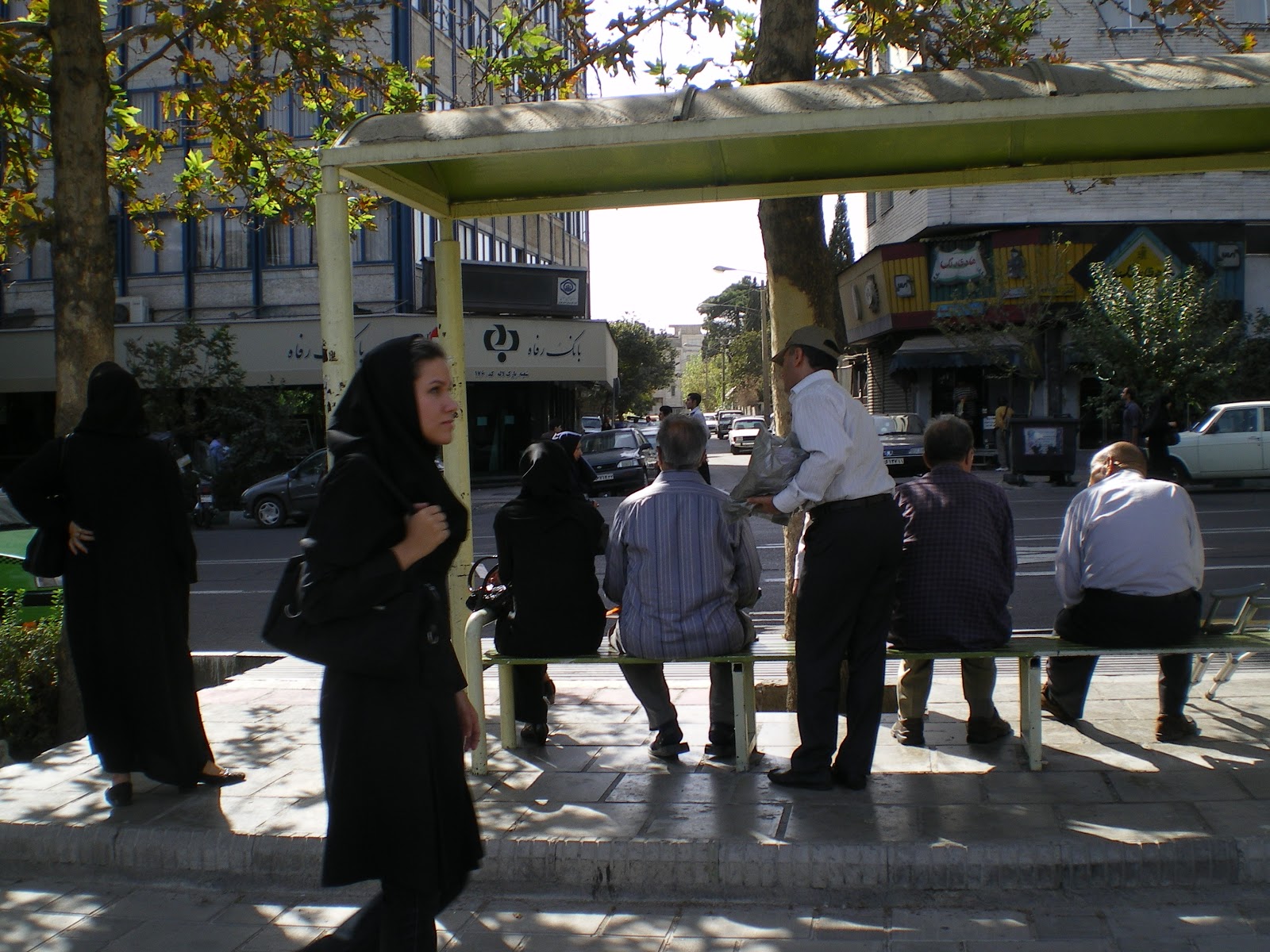
A bus stop in Tehran - note the young woman's rebelliously-displayed hair

Two: Shop owners or taxi drivers will decline your payment or give you discounts. Some cab drivers have charged me less than locals, simply because I am foreign. One must spend time in India, where foreigners are universally charged between two to one hundred times more for taxi rides (simply because they are unknowing enough to be cheated so severely), to know how nice such a gesture feels.

Dried apricots at a shop selling foodstuffs (Kashan)
Three: Dinner invitations flow like (metaphorical) wine. You only need to have met an Iranian and exchanged nary a few sentences before the invitation to eat at their home follows. On Eid-al-Fitr, which celebrates the end of the month of fasting, Ahmad, the one from the plane ride, invited me to his home, where we feasted on mixed lamb-chicken kebabs, tabouleh garnished with lemon and mint, long-grain rice with potatoes and this wet, slow-cooked lamb dish I’d never seen before but sure hope to see plenty more of. After dinner, he drove me home, accompanied by his childhood friend and two sons.

At Ahmah's home, enjoying a dinner feast thrown for me

With younger, English-speaking friends, I’ve attempted to use the guise of introducing them to the Western tradition of “going Dutch,” with mixed results. All of this kindness has had me wondering what it is that makes us in the West so ginger about inviting guests in for a meal? Is it some legacy of frosty Anglo-Saxon social code? Maybe we’re simply too caught up in our own, self-centred lives to want to make time for guests. Whatever the reasons, I think we could do with a little bit of ta’arof, though perhaps not to such Persian lengths, in our increasingly atomized, eating-lunch-at-our-cubicle, existences.


Soheila and Sepideh, on being 21 and beautiful in Tehran


With Soheila and Sepideh (and Ohmee!) at Park-e-Laleh, Tehran

Amir and I were walking towards the National Jewels Museum, home to the world's largest diamond, when two beautiful young women asked us for directions. For perhaps the first time in my life, as every guy might wish to happen, it turned out that they were going to the same place, and they accompanied us in.

The first thing I asked Amir, who quickly slid into the smooth, local translator role, was "Do they have any European blood?"

Soheila in particular is very pale, with green eyes and auburn hair, pulled straight back a la Gwen Stefani a few years back, a grey cotton scarf barely clinging to her remarkably high 'do. Sepideh, with her classical Persian features and olive skin, could easily pass as Spanish or Italian.

It turned out that I was totally off. They were Iranian to the core, hailing from two historic political towns, Tabriz and Hamadan originally but now in university in Tehran, studying accounting and anthropology. I've since realized that many Iranians look indistinguishable from Europeans, often hailing from different regions of the country.

They took forever at the museum, as girls surrounded by priceless Qajar-era royal jewels are apt to do, before we finally convinced them to come hang out at a park where we could talk more easily. We went to Park-e-Laleh in the centre of town, apparently a spot for discrete young couples to flirt. Unabashed performer that I am, I decided to give a little kung fu demonstration on the grass.

Wearing my thin cotton Indian trousers, I attempted a long tiger stance, and the already-sewn-up-once crotch area tore apart anew, with a fatalistic "Rrrrip!" I hobbled back, and spent the rest of the evening with my legs held together as if carrying a heavy bladder.

Sepideh washing her hands before heading to a cafe for some post-sunset food
Sepideh was far more outgoing and lively, and she answered most of the questions as we chatted about their interests in poetry, their chosen majors and desire to travel abroad. But for some reason it surprised me when she told us she wanted to stay at home after she married, that she was more traditional when it came to family. Soheila, on the other hand, was keen on continuing to work. Though they have a lot of male friends, there are no boy friends. And when I asked what they thought of local guys, the verdict was unflattering.

"These days, Tehrani boys are less genuine. After two months, they will stop being friends with you. They are not interested in love," Sepideh complained, leaving me to fill in the unspoken. When I told her that in the West, sometimes women use men with similar intentions, she smiled.

“Are you guys looking to get married soon?,” I asked at one point, and they and Amir all burst into laughter.

“Would you take one of them out of Iran with you?” Amir asked, jokingly.

“I’d have to ask my girlfriend first,” I responded, and more laughter followed.

Coming to Iran, I was happily surprised to see how relaxed and easygoing the girls were about hanging out with two unknown, foreign men. I’m not sure how receptive most American girls would be in the same situation. Amir, however, explained that Soheila and Sepideh were of a more liberal background. They disagreed with the conservative social direction Ahmadinejad has followed, and liked the more moderate previous president, Khatami. So in being so open and friendly with me, they were living out their own politics about gender relations in a small, but very direct way.

They asked me who I thought would win the US election, and I told them that I think it’ll be close. When I asked who they support, Amir immediately responded: “Of course Obama! He has a better policy toward Iran.”

It was getting dark and the azan song was sung over loudspeakers, signaling the end of fasting for that day. A park police motorbike swept by on a parallel path, and the girls shuddered a little.

“Let’s go eat,” Sepideh said. They didn’t want any trouble with the police about hanging out with boys, as happens increasingly often these days. So we walked to a nearby restaurant for osh, a tasty Iranian noodle dish that is eaten during Ramadan.

Osh, a noodle dish eaten during Ramadan
Sweet dates and tea for dessert

Tuesday, September 30, 2008

Taymaz: from Sydney homies to student activist and professional


Taymaz smoking hookah at a restaurant (my first meal in Iran)

I met Taymaz through my host. He’s 24, with thick, longish hair and light freckles across his nose and cheeks. When I met him, he came with a couple of Chinese colleagues and wore a hipster cap and horn-rimmed glasses, along with his casual work clothes, corduroy trousers and a white and blue striped shirt.

We clicked immediately. He spent two of his high school years in Sydney, so his English has a slight Australian twang. We’re both into music—he plays traditional Iranian drums and had a band in university—and both enjoy the “Harold and Kumar” movie franchise.

The beautiful home where I was hosted in Tehran
Laid back, Tay describes himself as a bit of a "hippie," unlike the more fashion-conscious Tehranis from whom he separates himself. At one point, while taking a shared taxi, the driver turned up his electronic pop song, leading Tay to shake his head in disgust, muttering: "pathetic." He's into traditional Persian folk.

Tehran, sprawling metropolis, shadowed by the Alborz mountains 

From 8:30 to 4:30 Saturday to Wednesday, he handles official customs for a Chinese construction firm that’s renovating one of Tehran’s largest towers: the Azadi Grand Hotel. At dinner, a traditional lamb kebab feast at one of the restaurants atop the Jamidiyeh Park that overlooks Tehran, we sat cross-legged on lovely, maroon-red Persian carpets. His colleagues, both from Beijing, were discussing their work here. Like me, their Farsi is minimal, and so they communicate with their Iranian colleagues in English.

Tay, pronounced “Thai, like the country,” is the only professional Iranian working on the project; the others are laborers. He expressed an admiration for the Chinese work ethic. Tehran's new, efficient metro system was built originally by Chinese workers, and contracting them to renovate the hotel, he thinks, will cut the project length from four to one years.

The clean, modern Tehran subway system (with optional separate cars for women)

“They built this toilet in only two days,” he pointed out, after we visited the hotel construction site, where the 200-odd Chinese workers, holed up in temporary dorms, rarely stray from. Their project managers are strict: when one of the others accompanied Tay home one night out of concern for his safety, he was penalized a month’s salary for leaving the site. And though Tay's been begging his foreign colleagues to come out and sample some Iranian culture over dinner, the two who came with us that evening were the first to accept.

I asked him how things fared in Sydney. I’d moved from Australia to the US around the same age, and know how painful a social landing pad high school can be when moving country.

“I had some trouble with the ‘homies,’” he laughed, referring to the Lebanese and Persian gangs around Sydney, who take their cue from the inner-city African-American ruffians of rap music and Hollywood lore. But he had a few close friends, including a Korean-Australian named Tim, who watched his back.

At first apprehensive, I was surprised when this security guard in Tehran allowed me to take a photo with him
After returning to Iran, Tay became involved in student politics, starting a group with a close friend that campaigned for improvements to campus life, such as better food and more qualified teachers. But after five months, the police cracked down, and a number of them were beaten and imprisoned. When I asked him about jail, he simply responded: “it’s not good.” I took his word. After that, the other students were too scared to participate and activities stopped.

Despite his experiences, whilst so many young Iranians are applying to emigrate to the West, Tay seems set on staying.

“Now, I have to think about my mum, my sister, my girlfriend...” he explained. Before he was working, he was studying veterinary science as a lab researcher.

“Now I have a good job. Maybe I’ll go back and do my PhD when I’m fifty!” he joked.


A street merchant selling recycled wire figurines

Monday, September 29, 2008

Fashionable Tehran


Nose job bandages are a common site amongst Tehran's image-conscious youth

 Tehran is a fashionable place.

Having arrived from India, where it seems that men’s fashion has held fast to the 70s—bell-bottom cuffs and clashing striped shirts are commonplace—wandering through Northern Tehran is like glimpsing High Kensington Street.

The bachelor-age men, with their immaculately styled hair, fitted shirts and jeans and European-pointed shoes revel in what Westerners once dubbed “metrosexual.” The Persians around my former city of Washington D.C. had a reputation for being greasy: a little too much gold chain and chest hair, far too much hair gel.*

What's not visible is this guy had a faux-hawk spike on top of his head too (Armenian quarter, Esfahan)

But here, they seem to bring a more tasteful hipness to their clothing. Flying down Modarres Expressway, a major north-south artery in this giant city of 15 million, one Tehranian in dark Ray Ban shades, his curls flapping in the wind, looked like he was on his way to a film set. Another, on the subway, wore a huge Versace-branded cowboy-belt buckle and brown pointed boots in a mixture of Clint Eastwood-meets-Enrique Iglesias suave. Dressed in my grey t-shirt and cargo pants, the epitome of “backpacker utilitarian” style, I feel utterly under-dressed amongst these veritable Beckhams among town.


Streetside calligraphy in the hills of Tehran (note the ladies' visible hair and blonde dye)

Young women, in turn, sport elaborate, dyed streaks blooming out of their black head scarves like something out of an iTunes commercial. They too are constantly in expensive sunglasses, their body-hugging coats and fine scarves give off an air of refined class. Their slim-leg jeans, in fashionably dark blue hues, snake down upon a mixture of flat-soled converse-styles to minimalist ballet shoes, with colors jumping from bright red and yellow patent leather to black. Nose jobs, popular apparently because plastic surgery is so affordable here, are broadcast to the world by tell-tale white bands across the recently-enhanced snozz.

Of, course, I’ve only really been around central and northern Tehran, the latter of which is the more upscale, Rodeo Drive-esque part of the city, with Benetton and Gucci stores vying for business along its commercial strips. It’ll be interesting to see how the rest of the country clothes itself.

This friendly couple were hanging out at a park

--

Note: For a hilarious take on this Persian stereotype, see the Persian villain character in the Australian film “Chopper.”

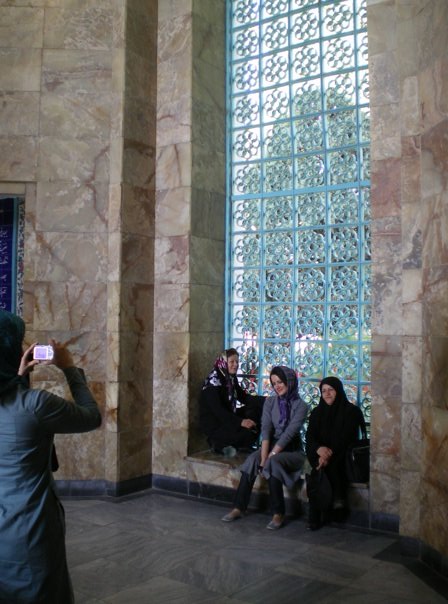
All dressed up at Sadi's tomb (Shiraz)
This shy young lady was practicing her English with me, at the behest of her mother (Kashan)

Sunday, September 28, 2008

Welcome to Couchsurfing Iran!

Salam!

Welcome to Couchsurfing Iran, a blog about my trip around Iran, in which I plan to stay with hosts and meet with locals all met via the website Couchsurfing.

I plan on sharing the stories, opinions and lives of these ordinary Iranians with an English-reading audience, in the hope that I might spread some good ole' peace and understanding during this increasingly tense and worrying time in Western-Iranian relations.

This blog is not about political issues per se, but rather is meant to offer an inside look at Iranians behind the headlines. Comments are welcome.

Why?

Because if you’re thinking of bombing a country, as a certain presidential candidate has literally sung the Beach Boys to, then I think you should know something about the people who live there beforehand. Surely Iraq has taught us that much.

Who am I?

I’m a 24 year old Australian currently based in Chengdu, China, where I study kung fu and teach English. Previously, I worked for a humanitarian agency in Silver Spring, MD. I have a B.A. in Government and Politics from the University of Maryland, College Park. When I have a chance, I like to attend indie rock concerts and do tai chi in public squares. My favourite Arabic numeral is panj, five, which looks like an upside-down heart. ۵